Wellness Practices: A Guide to Eight Ways of Holding Space, and the Business Behind Each
Wellness practices are the work of holding space for another person's healing, rest or change. Reiki, sound healing, breathwork, meditation, somatic work, integration circles, dance and shamanic practice look nothing alike from the outside. From the inside, the practitioners share the same week: sessions to book, a room to reserve, intake to collect, a circle to fill, a course to host, and a year of income and expenses to make sense of. This guide is the overview. Each practice has its own full post, linked below, with what it is, what the research shows, and what running it takes.
Why these eight practices belong together
They are the practices ColibriOS was built around, and they were chosen by the people who use it. The first people on it were a breathwork facilitator who also runs a school, a sound healer and a meditation retreat organizer. The list grew as their friends signed up. What ties them together is not the technique. It is that each practitioner is one person, or a small team, holding a booking calendar, a client list, a space and the books, and that most of the software on offer was built for a gym or a sales team.
How big the field is
The wellness economy
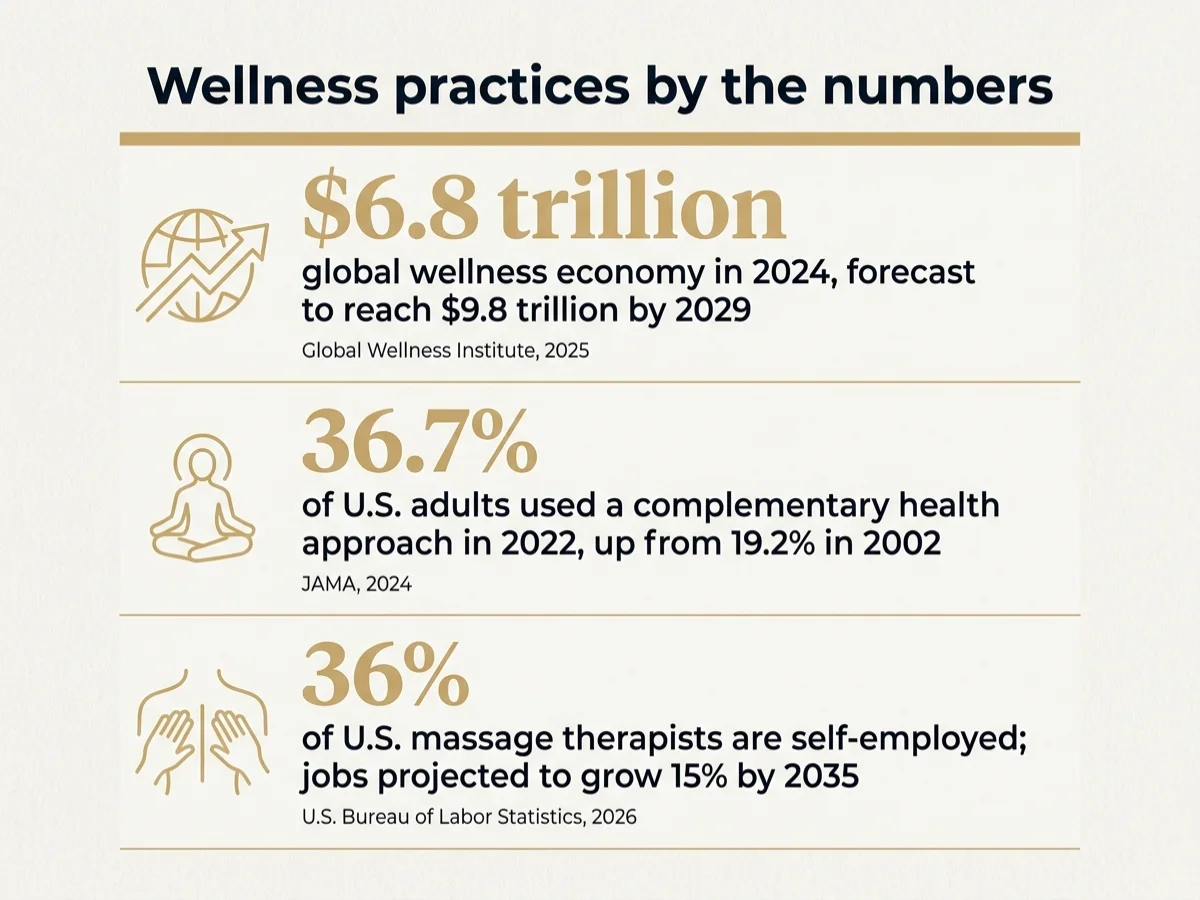
The Global Wellness Institute puts the global wellness economy at $6.8 trillion in 2024, up 7.9% in a year, and forecasts $9.8 trillion by 2029. From 2013 to 2024 wellness grew 6.5% a year while global GDP grew 3.2%. Mental wellness alone was $268 billion in 2024 and grew 12.4% a year over the previous five years.
One in three American adults
The NIH's National Center for Complementary and Integrative Health reported in JAMA that 36.7% of U.S. adults used at least one of seven complementary health approaches in 2022, up from 19.2% in 2002. Meditation led at 17.3%. About half of those people used the approaches for pain.
Health professionals should consider the extensive use of complementary practices in service and treatment planning and consider their risks and benefits.
Jonathan N. Davies, lead author, University of Melbourne, Scientific Reports
Practitioners who work for themselves
The federal government tracks one hands-on wellness occupation in detail. The Bureau of Labor Statistics counts about 155,400 massage therapists in 2025, 36% of them self-employed, with employment projected to grow 15% from 2025 to 2035, much faster than average, and median pay of $58,450. There is no occupation code for Reiki, breathwork, sound or shamanic practitioners, which tells you something about how new the field's business infrastructure is.
The eight practices
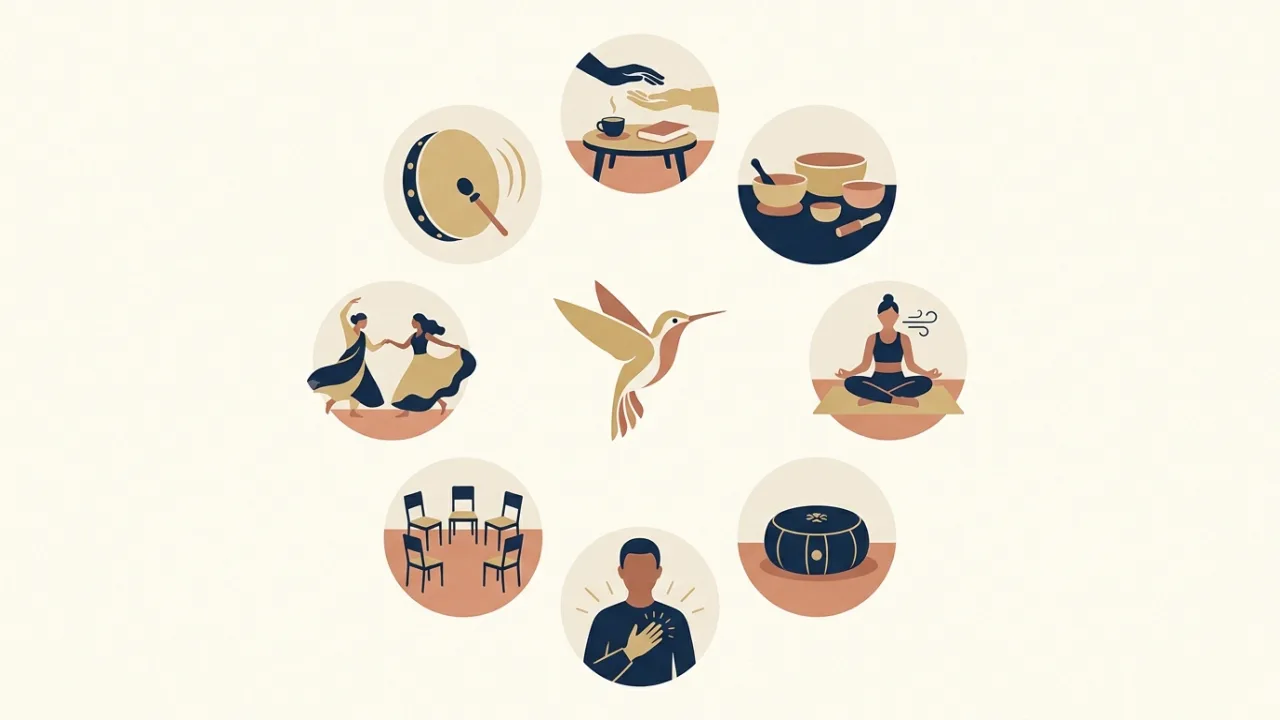
Each link goes to a full guide. The one-line summaries here are the short version.
Reiki
A hands-on or hands-near energy practice from Japan, taught in three levels. A Reiki practice is usually sessions, share circles and a certification track at once. Read the Reiki guide.
Sound healing
Singing bowls, gongs and voice, played for a room of people lying down. The business runs on a recurring series, a rented venue and add-ons at the door. Read the sound healing guide.
Breathwork
Deliberate breathing patterns, from five-minute exercises to 90-minute journeys. Facilitators run public drop-ins and closed containers, with intake before and integration after. Read the breathwork guide.
Meditation
The most practiced of the eight, used by about one in six American adults. Teachers hold a weekly sit, a multi-week course and private sessions. Read the meditation guide.
Somatic practice
Body-first work with sensation, breath and posture, often over a series of 10 to 20 sessions. The client record is the practice. Read the somatic practice guide.
Integration circles
Facilitated groups for the weeks after a ceremony, a legal psilocybin session or a journey. Privacy is the whole container. Read the integration circles guide.
Dance and movement
Ecstatic and conscious dance: no shoes, no talking, no steps. A weekly dance with a door, a venue and a DJ to pay. Read the dance and movement guide.
Shamanic practice
Drum-carried journeying, ceremony and circles, with screening and consent before anything is booked. Read the shamanic practice guide.
What every practice has in common
Booking and scheduling
Single sessions, recurring circles and multi-day containers, on one calendar. The recurring offering is the first thing to stop rebuilding by hand.
Intake and consent
Breathwork, somatic, integration and shamanic work all screen before the date. The form has to reach the booking, and the answers have to sit on the person's record.
A room
Most practitioners rent space by the hour or share it. A room reservation that lives next to the booking ends the group text.
The books, kept as you go
Every practitioner in this guide is running a business, and most are doing it alone. Income tracked as bookings are paid, expenses sorted as they happen, and a year-end report waiting rather than reconstructed. Colibri helps you organize your income and expenses. It is not a tax preparer, accountant, or a substitute for professional tax advice.
Where ColibriOS fits
One calm system for all of it, on your own website: sessions, circles, courses, rooms, intake, follow-up and the books. It also serves retreat hosts, holistic centers, event spaces and coaches.
See the plans, or create your account and start with the practice you hold most.
About the author
Stephanie Holbrook
Founder, ColibriOS
Stephanie Holbrook is the founder of ColibriOS. She runs Dragonfly Web Designs from Silver City, New Mexico, and is the friend people call when the bank statements and the mileage log need sorting before tax time. She builds software for practitioners and retreat hosts who would rather be with their people than in a spreadsheet, and writes about pricing, bookings and the bookkeeping side of running a practice.
More about the people behind ColibriOS- Breathwork: What It Is, What the Trials Show, and How to Run a Breathwork Practice (5 min read)
- Dance and Movement: What Ecstatic Dance Is, What the Research Found, and How to Fill the Floor (5 min read)
- Integration Circles: What Integration Is, Why the Numbers Are Growing, and How to Hold One (5 min read)
Run your practice from one place
Bookings, payments, retreats, and follow-up. Colibri keeps the admin light so you can stay present.
Join free until Cyber MondayGet the launch notes
One email when something worth knowing happens: launch pricing, what shipped, new videos. No noise. Unsubscribe any time.
By signing up you agree to receive emails from ColibriOS. Unsubscribe any time.