Shamanic Practice: What Shamanic Healing Is, What Has Been Studied, and How to Hold Ceremony With Care
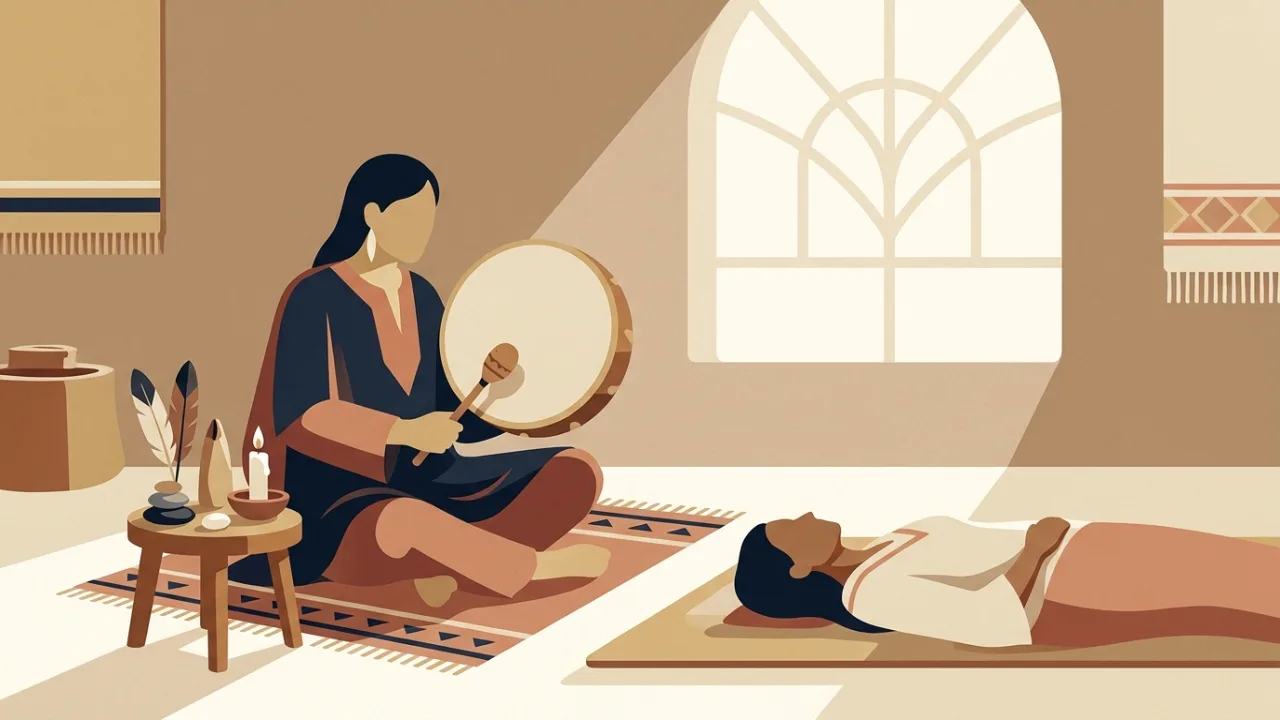
Shamanic practice is the oldest form of healing work in this series and the hardest to define, because it is not one tradition. Shamanism describes practices found across Siberia, the Americas, Africa and Asia in which a practitioner enters an altered state, usually through drumming, rattling or song, to work on behalf of a person or a community. Modern Western practitioners often trained in core shamanism, a distilled form taught since the 1980s, or with a specific lineage. This guide explains what the work is, what has actually been studied, and how to run a practice where screening, consent and privacy come before anything else.
It is one of eight practice guides in wellness practices: a guide to eight ways of holding space.
What shamanic practice is
Journeying, extraction, soul retrieval
The core technique is the journey: a steady drumbeat, typically four to seven beats a second, carries the practitioner into a trance state in which they seek information or perform healing for a client. Common forms of work include soul retrieval, extraction, power animal retrieval and psychopomp work. Sessions are usually private and one-to-one, 60 to 120 minutes, and end with the practitioner telling the client what they experienced and what to do with it.
Ceremony and circles
Many practitioners also hold group ceremony: a drum circle, a fire ceremony, a seasonal or lunar gathering, a journey circle where participants journey for themselves. Some hold plant medicine ceremony where it is legal. These are almost always private, invitation-only, and preceded by screening.
What has been studied about shamanic practice
There is one U.S. clinical trial of shamanic healing, run inside a major health system, and there is good survey data on how many Americans hold the beliefs the work rests on.
The Kaiser Permanente trial
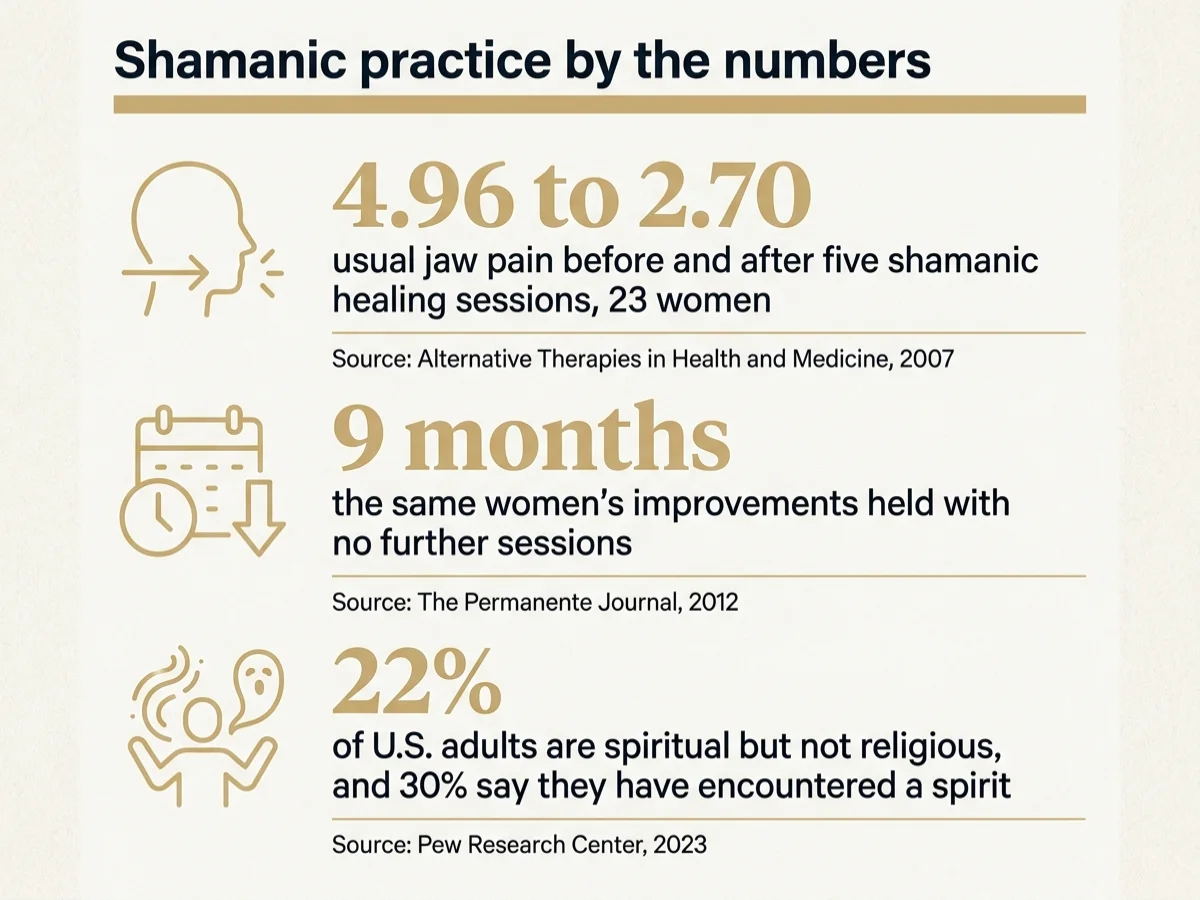
Researchers at Kaiser Permanente's Center for Health Research in Portland enrolled 23 women with diagnosed temporomandibular joint disorders and gave each five shamanic healing sessions. Mean usual pain fell from 4.96 to 2.70 on a 10-point scale and worst pain from 7.48 to 3.60. Only four of the 23 still met clinical criteria for the disorder at the end of treatment. A follow-up paper tracked the same women at one, three, six and nine months: the improvements in usual pain, worst pain and functional impairment had not changed.
Shamanic healing had lasting effects on TMDs in this small cohort of women.
Nancy H. Vuckovic, lead author, Kaiser Permanente Center for Health Research, The Permanente Journal
It was a phase 1 feasibility study with no control group and 23 participants, so it shows the format can be studied and that this group improved and stayed improved. It does not prove mechanism, and honest marketing says so.
Who holds these beliefs
Pew Research Center surveyed 11,201 U.S. adults in 2023 and found 22% describe themselves as spiritual but not religious, 30% say they have personally encountered a spirit or unseen spiritual force, and 57% believe animals other than humans can have their own spirits or spiritual energies. Only 14% say they belong to a spiritual community. A large share of the public already holds an animist view of the world, and most of them have nowhere to take it.
Running a shamanic practice
The admin of a shamanic practice is mostly about the first message and the last one: screening before someone books, and after-care once the work is done.
Screening and consent before the booking
Screening and consent scattered across texts, emails and paper forms is how something gets missed. An intake form attached to the session or the circle, completed before the person is confirmed, puts the answers on their record where you can read them before you say yes.
Ceremony that stays off the public page
A closed ceremony should not appear on a public calendar. A private offering that never shows on your site, with a link you send only to the people you have screened, keeps the circle where it belongs.
After-care, one person at a time, without doing it by hand
Following up with each person after a journey is part of the work, and doing it by hand for a circle of twelve is where it slips. A follow-up message and an optional integration call attached to the offering means everyone gets the check-in, and you decide who needs more.
Offerings, exchange and the books
Some practitioners work on exchange, some on a set fee, some on a sliding scale. Whatever the model, what came in and what went out for the drum, the space and the travel needs recording as it happens. Colibri helps you organize your income and expenses. It is not a tax preparer, accountant, or a substitute for professional tax advice.
Questions shamanic practitioners ask
Can I keep a ceremony off my public page?
Yes. A private offering never appears on your public site. You send the link to the people you have screened, and their intake and consent arrive before the date.
Can I collect screening and consent before someone books?
Attach an intake form to any session or circle. The answers sit on the person's record, and you decide who is confirmed.
Can I follow up after a journey?
Yes. Attach a follow-up message or an integration call to the session, so every person receives it and can book more support if they want it.
Where ColibriOS fits
Hold the screening, the consent, the private circle and the after-care in one place, so the work stays in the room and the admin stays out of it. The books are kept as you go, on your own website.
Read the other practice guides in wellness practices, see the plans, or create your account and set up your first private session.
About the author
Stephanie Holbrook
Founder, ColibriOS
Stephanie Holbrook is the founder of ColibriOS. She runs Dragonfly Web Designs from Silver City, New Mexico, and is the friend people call when the bank statements and the mileage log need sorting before tax time. She builds software for practitioners and retreat hosts who would rather be with their people than in a spreadsheet, and writes about pricing, bookings and the bookkeeping side of running a practice.
More about the people behind ColibriOS- Breathwork: What It Is, What the Trials Show, and How to Run a Breathwork Practice (5 min read)
- Dance and Movement: What Ecstatic Dance Is, What the Research Found, and How to Fill the Floor (5 min read)
- Integration Circles: What Integration Is, Why the Numbers Are Growing, and How to Hold One (5 min read)
Run your practice from one place
Bookings, payments, retreats, and follow-up. Colibri keeps the admin light so you can stay present.
Join free until Cyber MondayGet the launch notes
One email when something worth knowing happens: launch pricing, what shipped, new videos. No noise. Unsubscribe any time.
By signing up you agree to receive emails from ColibriOS. Unsubscribe any time.