Integration Circles: What Integration Is, Why the Numbers Are Growing, and How to Hold One

Integration circles are small, facilitated groups where people make sense of a non-ordinary experience after the fact: a plant medicine ceremony, a legal psilocybin session, a breathwork journey, a retreat. The circle does not provide the experience. It provides the weeks after it, when the insight either becomes a change in someone's life or fades. This guide covers what integration is, why the number of people who need it is climbing, and how to hold circles with the privacy the work demands.
It is one of eight practice guides in wellness practices: a guide to eight ways of holding space.
What integration is
The idea
A powerful experience is not the same as a changed life. Integration is the practice of taking what surfaced, in a session or a ceremony, and working it into daily habits, relationships and choices. That happens through talking, writing, movement, ritual and time. In clinical settings it is a scheduled part of the protocol. Outside the clinic, integration circles and one-to-one integration calls are how it gets done.
What a circle looks like
Six to twelve people meet weekly or every two weeks for 90 minutes to two hours. A facilitator opens with a grounding practice, each person shares without cross-talk, and the group closes with a practice or an intention. Many circles are ongoing and open to anyone screened; others are closed cohorts attached to a specific retreat or ceremony. Discretion is not a feature here. It is the whole container.
What the numbers say about integration
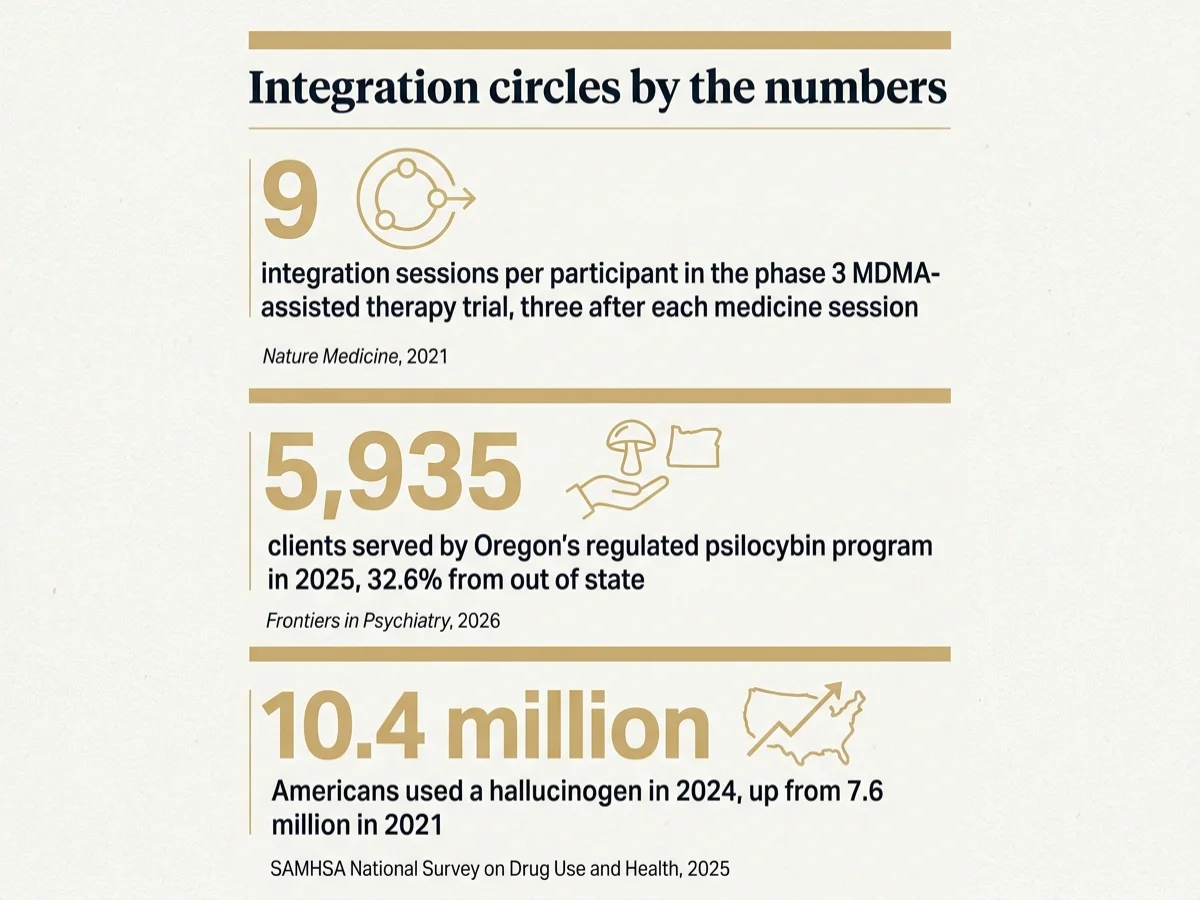
Three sources, from a phase 3 trial, a state program and a federal survey, tell the same story: more people are having these experiences, and integration is the part that is built into the best protocols.
Integration is most of the therapy hours
In the phase 3 trial of MDMA-assisted therapy for severe PTSD, 67% of the MDMA group no longer met PTSD criteria versus 32% on placebo. What gets less attention is the protocol's shape: each of the three medicine sessions was followed by three 90-minute integration sessions. Nine integration sessions per participant. In the best-studied clinical model, integration is not aftercare. It is three quarters of the contact time.
Each experimental session was followed by three 90-min integration sessions that were spaced ~1 week apart to allow the participant to understand and incorporate their experience.
Jennifer M. Mitchell, lead author, University of California San Francisco, Nature Medicine
Thousands leave a legal session every year
Oregon's regulated psilocybin program, the first in the country, served 5,935 clients in 5,375 administration sessions in 2025. A third of them, 32.6%, came from outside Oregon. Clients most often cited anxiety, depression and PTSD as their reasons. The program is non-medical by design, and the researchers observed that many clients appear to be seeking therapeutic outcomes through a non-medical pathway. Those people go home, often to another state, and the follow-up is whatever they can find. That is who integration circles serve.
The population is growing, and it is adults
The federal National Survey on Drug Use and Health found 10.4 million Americans aged 12 or older used a hallucinogen in 2024, up from 7.6 million in 2021. Among adults 26 and older the number rose from 4.7 million to 7.7 million. The growth is in grown adults, not students.
Holding integration circles as a practice
Integration facilitators run ongoing circles, closed cohorts and one-on-one calls, and the admin has to protect the people in them.
Privacy that the tools respect
A closed cohort should never appear on a public page, a public calendar or a shared link. Off-the-shelf event tools were built to promote, which is the opposite of what a sensitive circle needs. The offering has to be private by default, with its own schedule and its own intake, reachable only by the people you have screened.
Circles plus one-on-one calls
Most facilitators pair the group with individual integration calls, booked as needed or attached to the circle as a package. Both need to live on one calendar and one client record, so you can see in one place that someone attended three circles and has a call on Thursday at 4 PM.
Continuity across weeks
Integration happens over weeks, and the facilitator's job is continuity: remembering what someone shared two circles ago, sending the check-in they asked for, noticing who went quiet. Notes and follow-ups on the person's record, in order, are what make that possible for a circle of twelve.
The books, discreetly
Sliding-scale seats, a closed cohort with a deposit, a package of calls. Income needs tracking without a public receipt trail that names the offering in a way the client would not want. Colibri helps you organize your income and expenses. It is not a tax preparer, accountant, or a substitute for professional tax advice.
Questions integration facilitators ask
Can I run a private, invite-only circle?
Yes. Create closed cohorts that never appear on your public page, with their own schedule and intake, and share the link only with the people you have screened.
Can I bundle integration calls?
Attach post-circle integration calls to the offering so participants book continued support in one step.
Does the circle show up on a public calendar?
Not unless you choose to publish it. Private offerings are invisible to anyone without the link.
Where ColibriOS fits
Hold private circles, schedule one-on-one integration calls, and keep continuity of care, with the discretion this work asks for. The books are kept as you go, on your own website.
Read the other practice guides in wellness practices, see the plans, or create your account and set up your first private circle.
About the author
Stephanie Holbrook
Founder, ColibriOS
Stephanie Holbrook is the founder of ColibriOS. She runs Dragonfly Web Designs from Silver City, New Mexico, and is the friend people call when the bank statements and the mileage log need sorting before tax time. She builds software for practitioners and retreat hosts who would rather be with their people than in a spreadsheet, and writes about pricing, bookings and the bookkeeping side of running a practice.
More about the people behind ColibriOS- Breathwork: What It Is, What the Trials Show, and How to Run a Breathwork Practice (5 min read)
- Dance and Movement: What Ecstatic Dance Is, What the Research Found, and How to Fill the Floor (5 min read)
- Meditation: What It Is, How Many People Practice, and How to Run a Meditation Teaching Practice (5 min read)
Run your practice from one place
Bookings, payments, retreats, and follow-up. Colibri keeps the admin light so you can stay present.
Join free until Cyber MondayGet the launch notes
One email when something worth knowing happens: launch pricing, what shipped, new videos. No noise. Unsubscribe any time.
By signing up you agree to receive emails from ColibriOS. Unsubscribe any time.