Breathwork: What It Is, What the Trials Show, and How to Run a Breathwork Practice
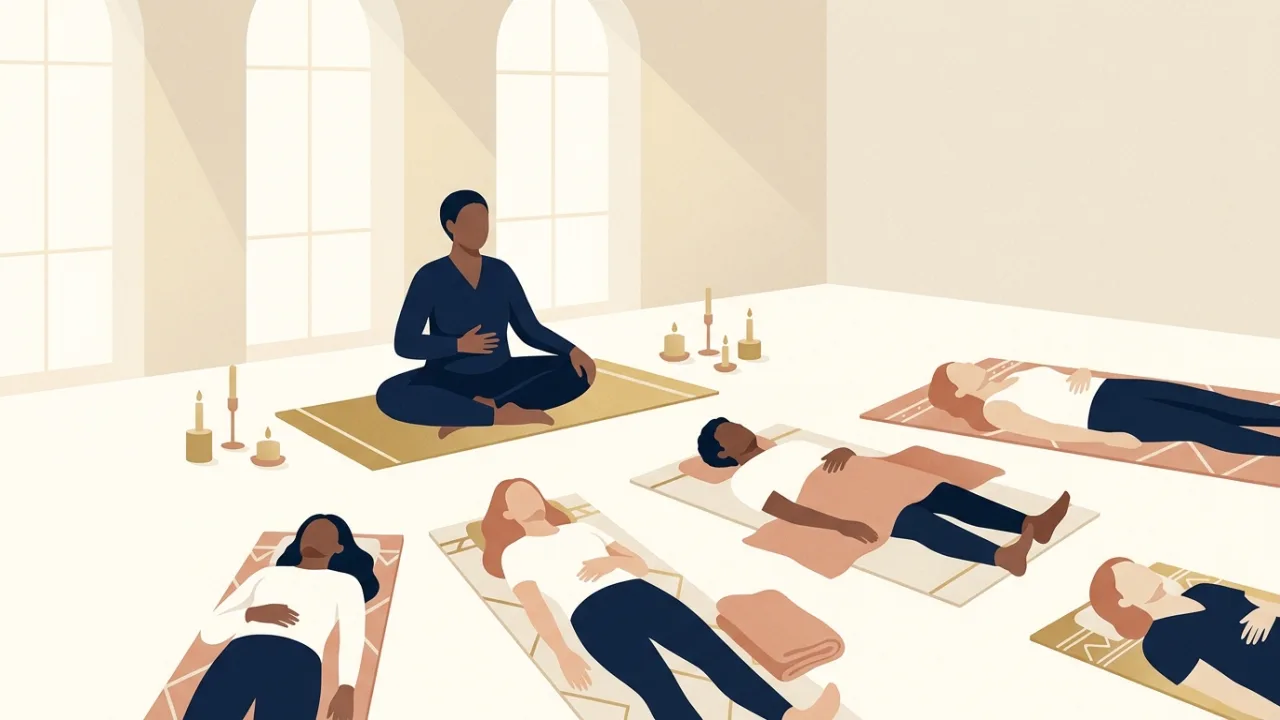
Breathwork is any practice that uses deliberate breathing patterns to change how the body and mind feel. That covers a wide range: a five-minute exercise before a meeting, a 90-minute conscious connected breathing journey with music and a facilitator kneeling beside you, and everything in between. This guide explains the main styles, what the randomized trials found, and what running a breathwork practice involves once the first container fills.
It is one of eight practice guides in wellness practices: a guide to eight ways of holding space.
What breathwork is
The main styles
Regulated breathing, such as box breathing, coherent breathing at about six breaths a minute, and the physiological sigh, aims to settle the nervous system quickly. Conscious connected breathing, taught under names like Holotropic, Rebirthing and Transformational Breath, uses continuous circular breathing for 30 to 90 minutes and can bring up strong emotion and physical sensation. Pranayama comes from the yoga tradition and includes alternate-nostril and breath retention practices. Most facilitators teach one main style and borrow from the others.
What a session looks like
A group session opens with intake and a safety briefing. Participants lie down, the facilitator guides the breath pattern and often plays music, and the active phase runs 20 to 60 minutes. A rest and integration period follows, with time to talk or write. Because connected breathing can be intense, facilitators screen for pregnancy, cardiovascular conditions, seizure history and recent trauma before the session, not during it.
What the research says about breathwork
Breathwork has more randomized evidence than most practices in this series, and the authors of that evidence are careful about how far it goes.
A meta-analysis of randomized trials
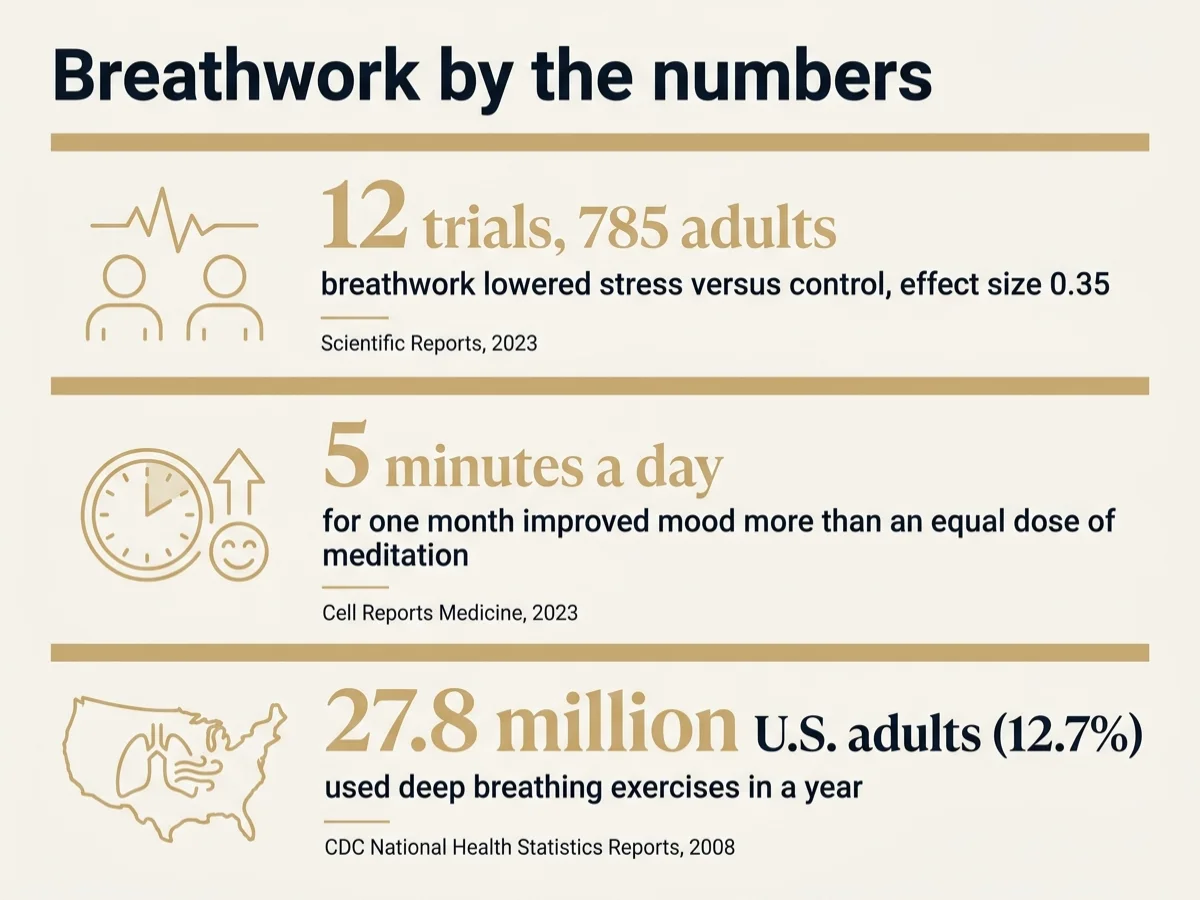
Researchers at the University of Sussex pooled 12 randomized controlled trials with 785 adults and found breathwork lowered self-reported stress compared with control, a small-to-medium effect (Hedges g of -0.35). Anxiety across 20 trials and depressive symptoms across 18 trials showed similar effects. The authors also noted that most trials had a moderate risk of bias, which is the caveat to carry into your marketing.
Overall, results showed that breathwork may be effective for improving stress and mental health.
Guy William Fincham, lead author, University of Sussex, Scientific Reports
Five minutes a day
A Stanford trial enrolled 108 people and had them do five minutes a day of a breathing exercise or of mindfulness meditation for a month. The breathing groups improved mood and lowered respiratory rate more than the meditation group, and cyclic sighing, a double inhale through the nose and a long exhale through the mouth, was the strongest of the three patterns tested. For a facilitator, that supports short homework between sessions and low-commitment intro offers.
How many people already breathe on purpose
The CDC's 2007 survey found 27.8 million U.S. adults, 12.7%, had used deep breathing exercises in the previous year, the second most used complementary practice after natural products. Your prospective clients are not new to breathing exercises. What a facilitator sells is depth, structure and a held container.
Running a breathwork practice
A breathwork facilitator holds two kinds of offering at once: public drop-in classes anyone can book, and closed multi-week containers with a fixed cohort. The admin has to respect the difference.

Intake and consent that reach the booking
Trauma-informed intake is not optional in this work, and it is usually collected on a form that does not know who booked. The fix is to attach the intake to the offering, so the answers arrive with the registration and you know before the date who needs a conversation first.
Drop-ins and closed containers side by side
A Tuesday drop-in class is public and repeats weekly. A six-week container is private, has a fixed group, and never appears on the public page. Both need to sit on one calendar, in one client list, without the private one leaking into the public listing.
Integration after the journey
The session is not over when the music stops. A follow-up message the next day, an integration call in the following week, and a way for people to book continued support are what turn a one-time journey into a client. Doing that by hand for twenty people after every session is where facilitators burn out.
The room and the books
Studios rent by the hour and containers need the same room on the same night for six weeks. A room reservation that sits with the booking removes the guesswork, and every ticket and deposit lands in your books the day it is paid. Colibri helps you organize your income and expenses. It is not a tax preparer, accountant, or a substitute for professional tax advice.
Questions breathwork facilitators ask
Can I collect intake and consent before a session?
Yes. Attach intake forms to any offering; participants complete them when they register, and the answers sit on their record.
Can I run a closed multi-week container?
Create a private, multi-session container with a fixed cohort, separate from your public drop-in offerings, on the same calendar.
Can I follow up after a journey without doing it by hand?
Yes. Attach an integration call or a follow-up message to the offering, so every participant gets it without a separate step.
Where ColibriOS fits
Hold the booking, the intake, the room and the post-journey integration in one place, so you can hold the people. The books are kept as you go, on your own website.
See the other practice guides in wellness practices, read the plans, or create your account and build your first container.
About the author

Stephanie Holbrook
Founder, ColibriOS
Stephanie Holbrook is the founder of ColibriOS. She runs Dragonfly Web Designs from Silver City, New Mexico, and is the friend people call when the bank statements and the mileage log need sorting before tax time. She builds software for practitioners and retreat hosts who would rather be with their people than in a spreadsheet, and writes about pricing, bookings and the bookkeeping side of running a practice.
More about the people behind ColibriOS- Dance and Movement: What Ecstatic Dance Is, What the Research Found, and How to Fill the Floor (5 min read)
- Integration Circles: What Integration Is, Why the Numbers Are Growing, and How to Hold One (5 min read)
- Meditation: What It Is, How Many People Practice, and How to Run a Meditation Teaching Practice (5 min read)
Run your practice from one place
Bookings, payments, retreats, and follow-up. Colibri keeps the admin light so you can stay present.
Join free until Cyber MondayGet the launch notes
One email when something worth knowing happens: launch pricing, what shipped, new videos. No noise. Unsubscribe any time.
By signing up you agree to receive emails from ColibriOS. Unsubscribe any time.