Dance and Movement: What Ecstatic Dance Is, What the Research Found, and How to Fill the Floor
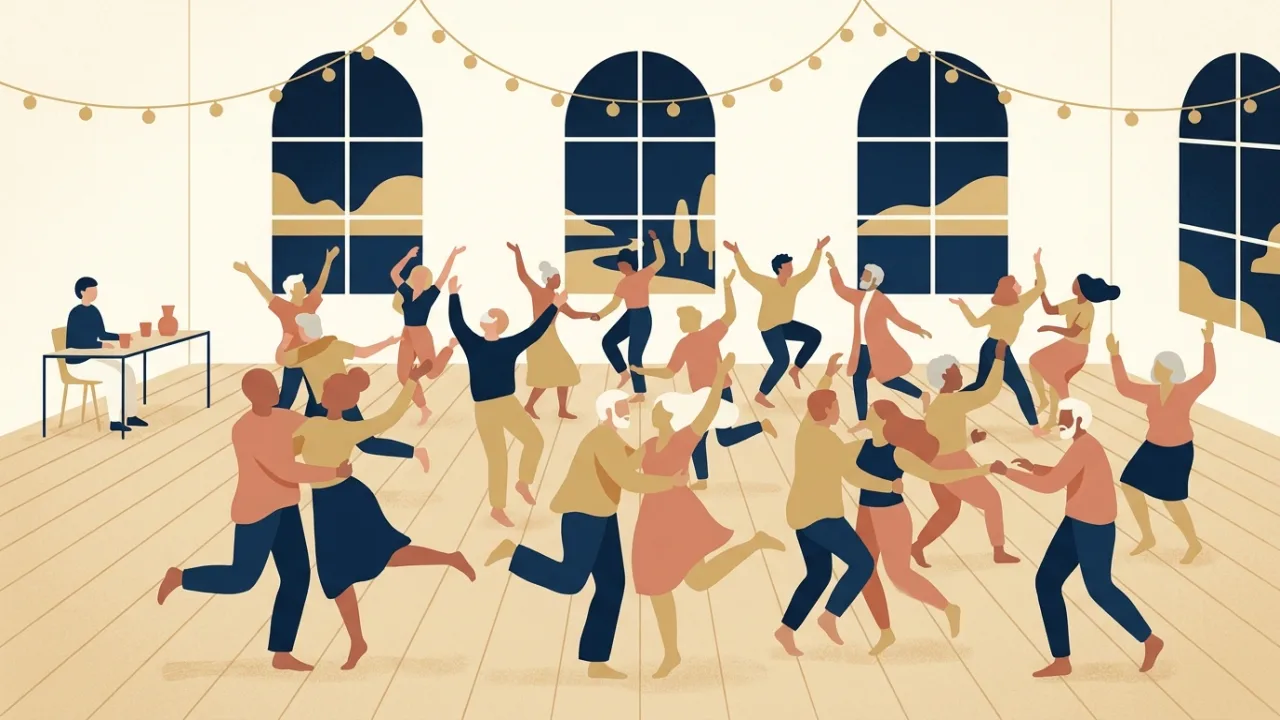
Dance and movement practices ask nothing of you except that you move. Ecstatic dance, conscious dance, 5Rhythms, Open Floor and the many local variations share a few rules: no talking on the floor, no shoes, no substances, and no steps to get right. A facilitator holds the space and the music, and a room full of people moves for two hours. This guide covers what these practices are, what the research on dance and mental health found, and what it takes to run a weekly dance that is filled and paid before the doors open.
It is one of eight practice guides in wellness practices: a guide to eight ways of holding space.
What dance and movement practice is
Ecstatic and conscious dance
An ecstatic dance is a facilitated, freeform dance session, usually 90 minutes to two hours, that follows a musical arc: a warm-up, a build to high energy, a peak, and a slow return to stillness. The facilitator or DJ curates the arc. Participants dance alone, with others, or lying on the floor, as they choose. Conscious dance, 5Rhythms and Open Floor add more structure, such as named phases or guided prompts, but rest on the same premise.
Movement workshops and series
Beyond the weekly dance, facilitators run workshops and multi-week series: a six-week movement and voice course, a weekend intensive, a monthly women's or men's circle with dance at its center. Some add a sober social night. The weekly dance builds the community; the series pays the facilitator.
What the research says about dance and movement
Dance has a larger body of controlled research than most people expect, and it is growing fast.
A meta-analysis of 41 studies
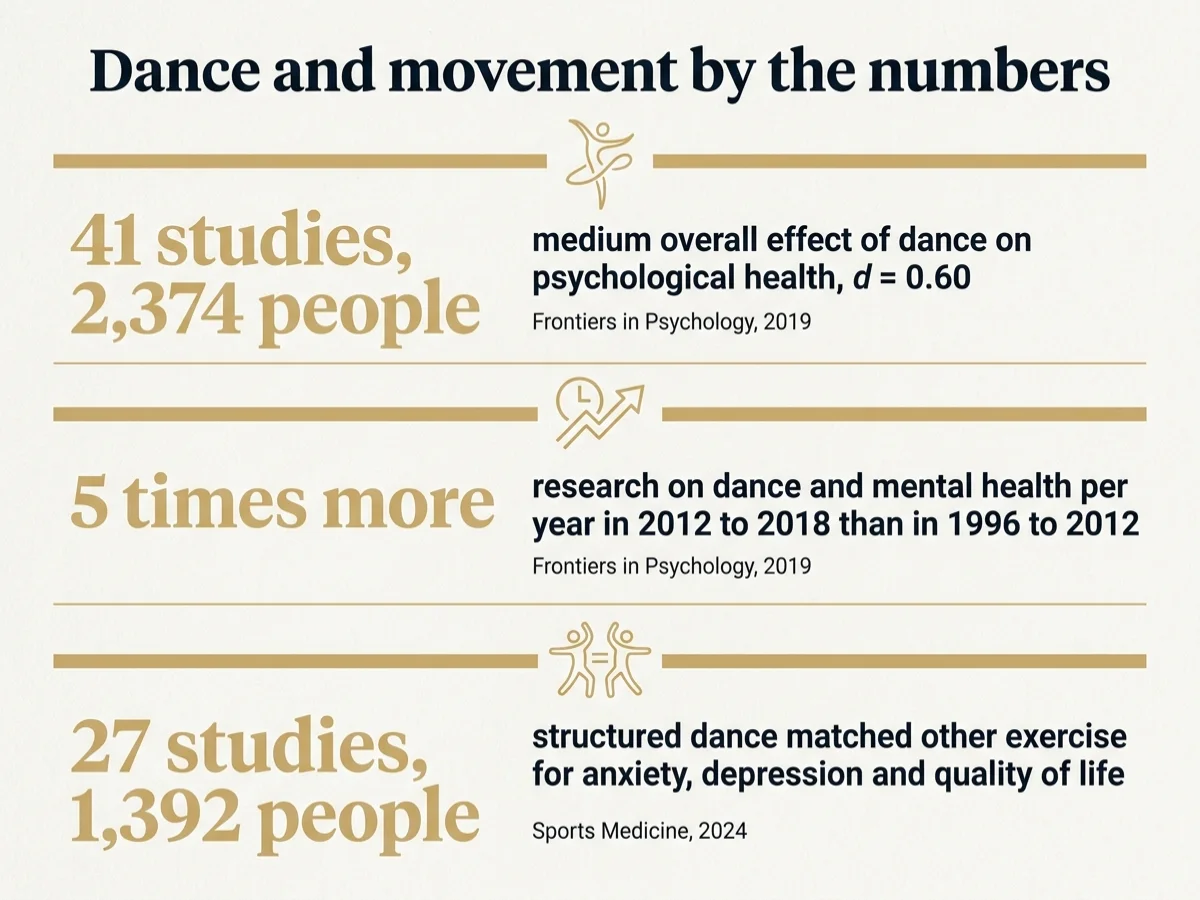
A 2019 update to the main meta-analysis on dance movement therapy and dance interventions pooled 41 controlled studies with 2,374 participants. The overall effect on psychological health was medium (d of 0.60), with the largest effects on interpersonal skills and quality of life, and most effects were stable or slightly larger at 22-week follow-up. The same paper counted research output rising from 1.3 studies a year between 1996 and 2012 to 6.8 a year between 2012 and 2018.
Results suggest that DMT decreases depression and anxiety and increases quality of life and interpersonal and cognitive skills, whereas dance interventions increase (psycho-)motor skills.
Sabine C. Koch, lead author, Alanus University, Frontiers in Psychology
Dance versus the gym
A 2024 systematic review in Sports Medicine compared structured dance with other structured exercise across 27 studies and 1,392 participants. Dance was as effective as other exercise for anxiety, depression and quality of life, with preliminary evidence that it did better for motivation, memory, social cognition and reducing distress. For a facilitator, that is the answer to "why not just go to the gym."
There is no reliable national count of how many people attend ecstatic dance, so we do not quote one.
Running a dance and movement practice
A dance night has more moving parts than a class: a venue, a DJ or facilitator, a door, and a crowd that pays in three different ways.
The door
Cash at the door and a headcount nobody wrote down is the traditional model, and it is how facilitators end the night not knowing what they made. Selling tickets ahead on your own site, then recording door payments at check-in from your phone, puts the headcount and the income for the night in one place.
The weekly dance, built once
Rebuilding the same weekly dance by hand and posting the link everywhere again is an hour a week that adds up to a working week a year. Set the dance as a recurring series, with its price, cap and reminders, and share one link that always points at the next one.
What the night actually made
A venue to pay, a DJ to pay, and forty tickets at $20. The number that matters is what is left, per night, after the room and the music. Seeing it the morning after, rather than reconstructing it in April, is what makes the series sustainable. Colibri helps you organize your income and expenses. It is not a tax preparer, accountant, or a substitute for professional tax advice.
Workshops and series alongside the dance
A weekly dance and a six-week workshop belong on the same calendar, the same client list and the same books. The people who come to the dance are the people who will book the workshop, if you can see who they are.
Questions dance facilitators ask
Can people still pay at the door?
Yes. Sell tickets ahead on your own site and record door payments at check-in, so the headcount and the income for the night land in one place.
Can I run a weekly dance and a workshop series from the same place?
Create the weekly dance as a recurring series and the workshop as a multi-week container. Both share one calendar, one client list and one set of books.
Can I check people in from my phone?
Yes. The door list works on a phone, and a door payment is recorded in the same tap as the check-in.
Where ColibriOS fits
Set the weekly dance once, sell the ticket on your own site, check people in from your phone, and see what each night made after the venue and the DJ.
Read the other practice guides in wellness practices, see the plans, or create your account and set up your first dance.
About the author

Stephanie Holbrook
Founder, ColibriOS
Stephanie Holbrook is the founder of ColibriOS. She runs Dragonfly Web Designs from Silver City, New Mexico, and is the friend people call when the bank statements and the mileage log need sorting before tax time. She builds software for practitioners and retreat hosts who would rather be with their people than in a spreadsheet, and writes about pricing, bookings and the bookkeeping side of running a practice.
More about the people behind ColibriOS- Breathwork: What It Is, What the Trials Show, and How to Run a Breathwork Practice (5 min read)
- Integration Circles: What Integration Is, Why the Numbers Are Growing, and How to Hold One (5 min read)
- Meditation: What It Is, How Many People Practice, and How to Run a Meditation Teaching Practice (5 min read)
Run your practice from one place
Bookings, payments, retreats, and follow-up. Colibri keeps the admin light so you can stay present.
Join free until Cyber MondayGet the launch notes
One email when something worth knowing happens: launch pricing, what shipped, new videos. No noise. Unsubscribe any time.
By signing up you agree to receive emails from ColibriOS. Unsubscribe any time.