Reiki: What the Practice Is, What the Research Shows, and How to Run a Reiki Practice
Reiki is a hands-on, or hands-near, energy practice that started in Japan in the 1920s and now shows up in hospitals, hospices, spas and hundreds of small home studios. If you practice Reiki, or you are thinking about booking a session, this guide covers the three things people ask most: what actually happens on the table, what the published research does and does not say, and what it takes to run a Reiki practice as a real business.
This is one of eight practice guides. The overview of all of them is in wellness practices: a guide to eight ways of holding space.
What Reiki is
The word comes from two Japanese characters, rei (universal) and ki (life energy). Mikao Usui developed the system in 1922, and the version most Western practitioners learn today descends from his student Chujiro Hayashi and from Hawayo Takata, who brought the practice to Hawaii in the 1930s.
What happens in a Reiki session
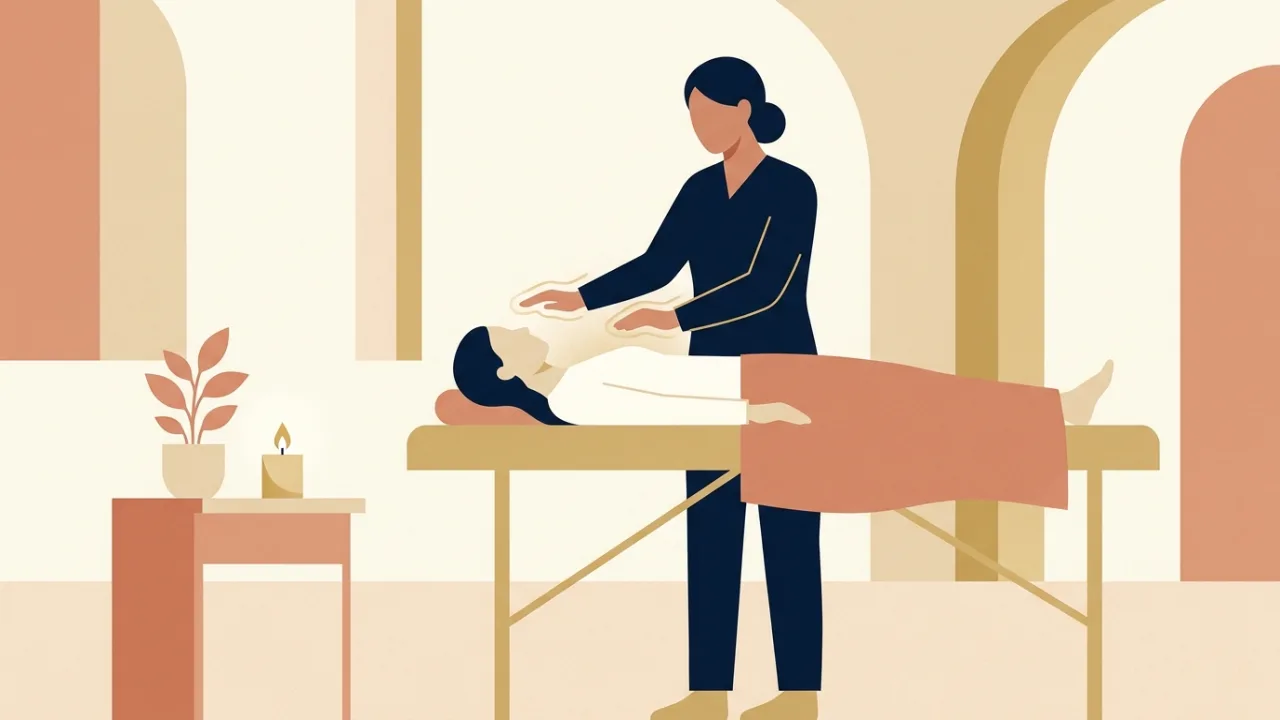
A client lies fully clothed on a treatment table. The practitioner places their hands lightly on or just above a series of positions, usually starting at the head and moving toward the feet, holding each position for a few minutes. Sessions run 45 to 90 minutes. There is no manipulation of tissue, which is why Reiki sits comfortably alongside massage, counseling and medical treatment rather than competing with them.
The three levels of Reiki training
Most lineages teach in three stages. Reiki I covers self-treatment and treating others by hand. Reiki II adds the symbols and distance practice. Reiki III, or Master level, includes teaching and giving attunements. A practitioner who teaches all three runs, in effect, a small school alongside a session practice, which matters a lot when it comes to the admin side below.
What the research says about Reiki
The honest summary is that Reiki has a modest evidence base that leans on program evaluations and patient-reported outcomes, with few large controlled trials. Here is what the primary sources show.
How many people use Reiki
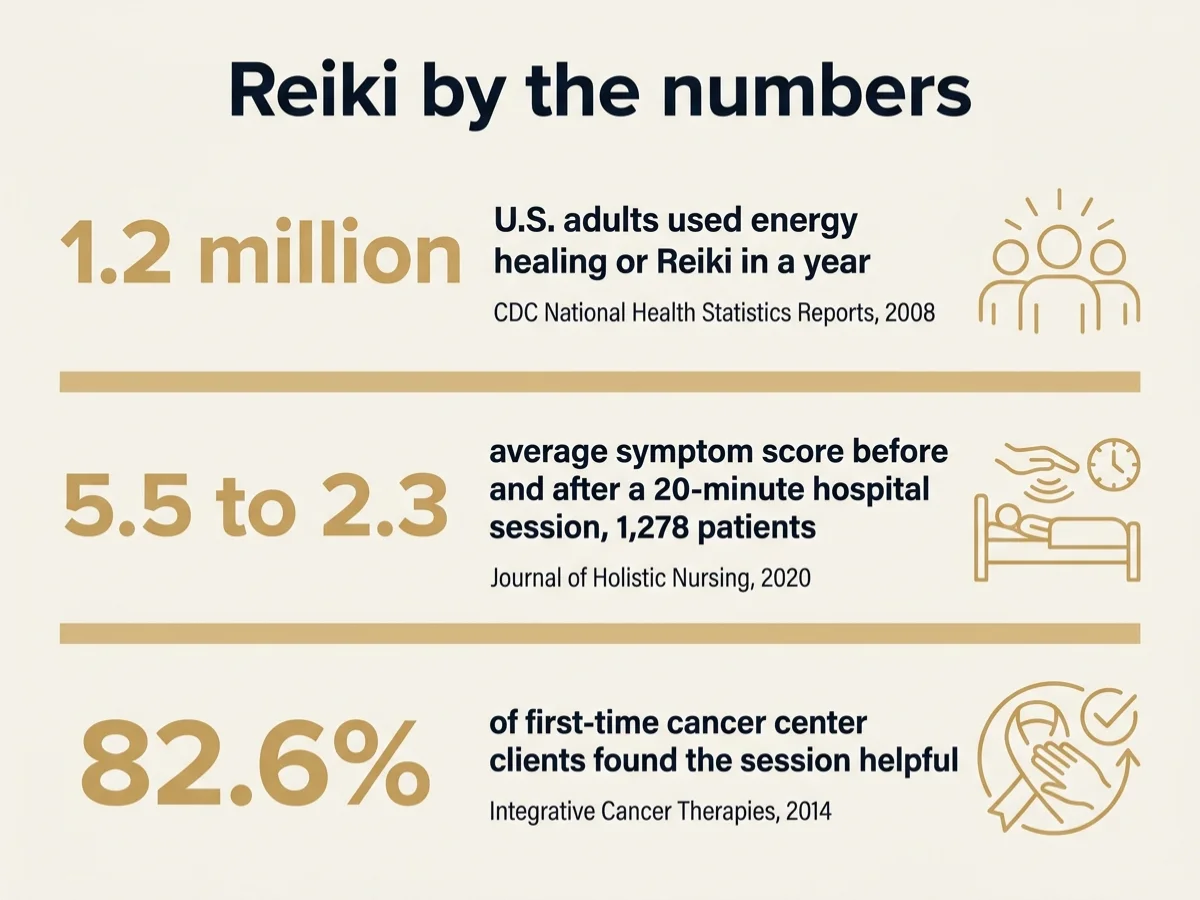
The CDC's National Health Statistics Report on complementary medicine use found that 1.2 million U.S. adults, 0.5% of the adult population, had used energy healing therapy or Reiki in the previous year. That is a niche nationally, which is exactly why a Reiki practice grows through referrals and repeat clients rather than through mass advertising.
What hospital programs report
A volunteer program at Sanford USD Medical Center in the Midwest gave 1,278 hospitalized patients a 20-minute Reiki session over 26 months. Patients rated their main symptom before and after; the average score fell from 5.52 to 2.25. At the University of Pennsylvania's cancer center, a program evaluation of 213 first-time sessions found distress scores fell from 3.80 to 1.55, anxiety fell from 4.05 to 1.44, 82.6% of participants found the session helpful, and 73.7% planned to keep using Reiki.
An integrative Reiki volunteer program shows promise as a component of supportive care for cancer patients.
Kimberly A. Fleisher, lead author, University of Pennsylvania, Integrative Cancer Therapies
Those are before-and-after measurements without a control group, so they show what clients report, not proof of mechanism. For a practitioner, the useful numbers are the last two: most first-timers found it helpful and most intended to come back. Retention is the whole business.
Running a Reiki practice
A working Reiki practitioner usually carries three businesses in one: private sessions, group share circles, and a course track from Reiki I to Master. The admin gets messy at the seams between them.

Sessions, circles and courses on one calendar
The most common setup we see is a booking tool for sessions, a spreadsheet for course students and a separate inbox for every client. Each tool knows one piece of the person. A share circle that meets monthly and a Reiki II weekend need to sit on the same calendar as the Tuesday afternoon sessions, or you will double-book yourself.
Attunements, certificates and students who keep practicing
A Reiki course is not finished when the weekend ends. Students need the manual, the hand positions, a place to log their 21-day self-treatment, and a way to ask questions. Hosting the course material online and bundling it with the in-person attunement keeps students practicing between meetings, and it gives you a certification track you can sell again next season without rebuilding it.
Treatment rooms and shared space
Many practitioners rent a room by the hour in a holistic center or share a studio with a massage therapist. Without a shared calendar you are texting to find out whether the room is free at 2 PM on Thursday. A room reservation that lives next to the booking removes that message entirely.
Money, tracked as it happens
Sessions at $90, a circle at $20 a seat and a Reiki I weekend at $350 add up to a real income, and at tax time you need to know what came in and what went out for table sheets, rent and continuing education. Colibri helps you organize your income and expenses. It is not a tax preparer, accountant, or a substitute for professional tax advice.
Questions Reiki practitioners ask
Can I run both 1:1 sessions and group circles?
Yes. Book private sessions, recurring share circles and multi-week courses from the same calendar, so nothing overlaps.
Can I sell my Reiki course online?
Host the course in ColibriOS and bundle it with in-person attunements, so students keep practicing between sessions and pay once for the whole track.
Do I need a separate tool for the treatment room?
No. Reserve the room as part of the booking, or open it to visiting practitioners with its own calendar and rate.
Where ColibriOS fits
From a single attunement to a full certification track, ColibriOS holds the booking, the teaching, the space and the follow-up in one place, on your own website. It also keeps the books as you go, so the year-end report is waiting rather than reconstructed.
Read the other practice guides in wellness practices, see the plans, or create your account and set up your first session type in a few minutes.
About the author

Stephanie Holbrook
Founder, ColibriOS
Stephanie Holbrook is the founder of ColibriOS. She runs Dragonfly Web Designs from Silver City, New Mexico, and is the friend people call when the bank statements and the mileage log need sorting before tax time. She builds software for practitioners and retreat hosts who would rather be with their people than in a spreadsheet, and writes about pricing, bookings and the bookkeeping side of running a practice.
More about the people behind ColibriOS- Breathwork: What It Is, What the Trials Show, and How to Run a Breathwork Practice (5 min read)
- Dance and Movement: What Ecstatic Dance Is, What the Research Found, and How to Fill the Floor (5 min read)
- Integration Circles: What Integration Is, Why the Numbers Are Growing, and How to Hold One (5 min read)
Run your practice from one place
Bookings, payments, retreats, and follow-up. Colibri keeps the admin light so you can stay present.
Join free until Cyber MondayGet the launch notes
One email when something worth knowing happens: launch pricing, what shipped, new videos. No noise. Unsubscribe any time.
By signing up you agree to receive emails from ColibriOS. Unsubscribe any time.