Somatic Practice: What Somatic Work Is, What the Studies Show, and How to Run a Somatic Practice

Somatic practice is body-first work. Instead of starting with the story, a somatic practitioner starts with sensation: where the breath stops, what the shoulders do, what happens in the belly when a memory comes up. The field includes Somatic Experiencing, Hakomi, sensorimotor approaches, embodiment coaching and movement-based methods such as Feldenkrais. This guide explains what somatic work is, what the research shows, and what it takes to run a somatic practice where client journeys last months, not sessions.
It is one of eight practice guides collected in wellness practices: a guide to eight ways of holding space.
What somatic practice is
The core idea
Somatic methods rest on the observation that stress and trauma are held in the body's patterns of tension, posture and breath, and that working with those patterns directly can release what talking alone does not reach. Sessions move slowly. The practitioner tracks small shifts and helps the client notice them, build resources, and return to a settled state again and again until the body learns the way back.
What a session looks like
A one-to-one somatic session is usually 60 to 90 minutes, seated or lying down, sometimes with light touch, sometimes with none. Group work takes the form of embodiment classes and multi-week courses in which participants move, stand, sway and notice. Most practitioners see clients for a series of sessions, often 10 to 20, over several months.
What the research says about somatic practice
Somatic work has one strong randomized trial, a small evidence base, and a great deal of clinical experience. Here is what can be sourced.
The Somatic Experiencing trial
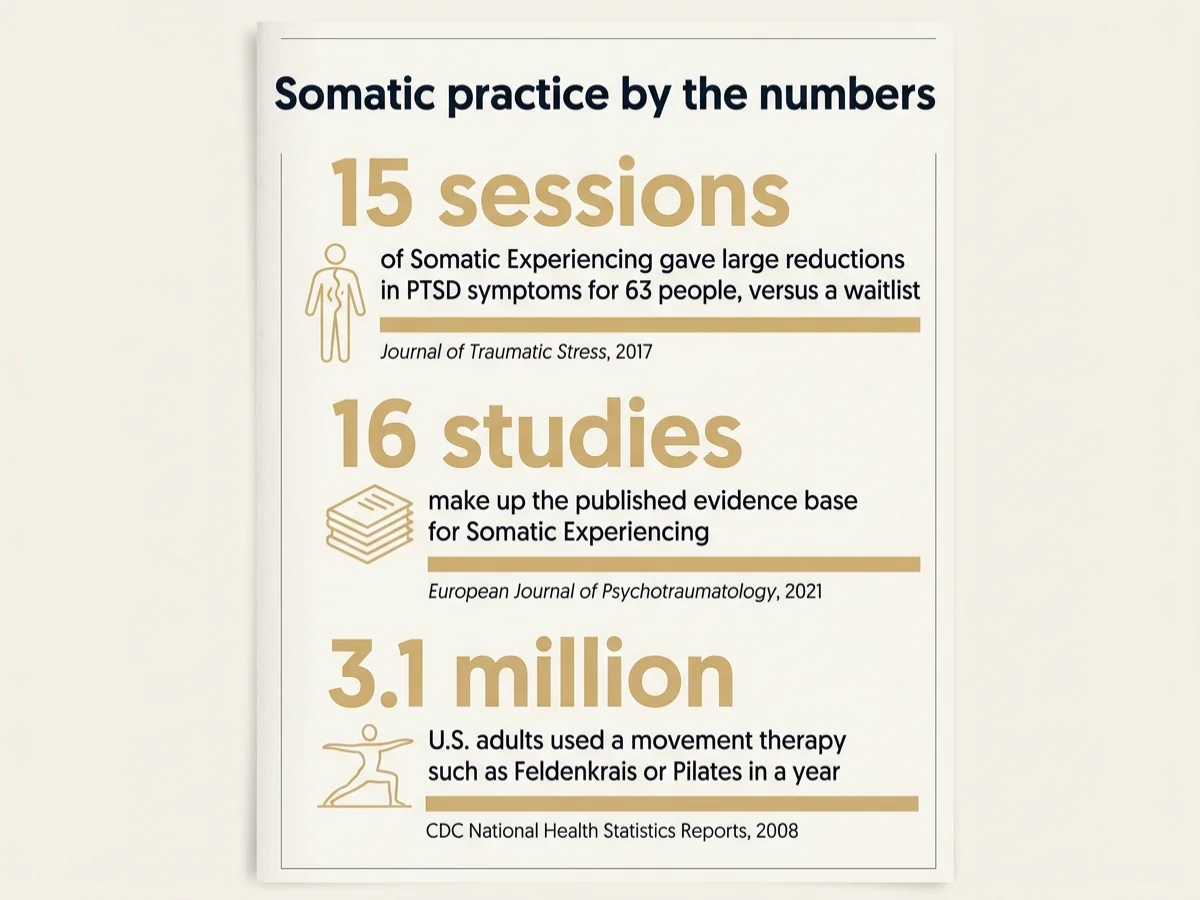
The first randomized controlled trial of Somatic Experiencing enrolled 63 people with PTSD and gave half of them 15 weekly sessions while the rest waited. The treated group showed large reductions in posttraumatic symptom severity (Cohen's d of 0.94 to 1.26) and in depression (d of 0.70 to 1.08). Fifteen sessions is also a concrete program length a practitioner can package and price.
This randomized controlled study of SE shows positive results indicating SE may be an effective therapy method for PTSD.
Danny Brom, lead author, Herzog Israel Center for the Treatment of Psychotrauma, Journal of Traumatic Stress
How big the evidence base is
A 2021 scoping review screened 83 articles and found 16 studies of Somatic Experiencing that met its criteria, concluding there is preliminary evidence for positive effects on PTSD-related symptoms. The review also named the method's specific ingredients: resource orientation and the careful use of touch. Sixteen studies is early-stage, so the honest phrasing is "early evidence," and it is enough to say with a straight face.
Body-based methods in national data
The CDC's 2007 survey counted 3.1 million U.S. adults, 1.5%, who had used a movement therapy such as Feldenkrais, the Alexander Technique, Pilates or Trager in the previous year, the first year the question was asked. Pilates made up most of it. The somatic field is small in national terms, which is another way of saying a practitioner's clients come from relationship and referral.
Running a somatic practice
The defining feature of a somatic practice is the long journey. A client may be with you for six months. Every session builds on the last, and the notes are the work.

One record per person
Notes in one app, bookings in another, and the intake in an email thread means the story of a client is scattered across three places. A single client record that holds every session, note and follow-up lets you open one page before each session and see the whole arc.
The embodiment course
Many somatic practitioners teach a group course alongside their one-to-one work: six weeks of embodied movement, a nervous system basics series, a practitioner training. Hosting that course in the same place clients book means the people in the course and the people on the table are one list, not two.
Shared studio time
Somatic work often happens in a room shared with other practitioners. Booking studio time with a shared calendar, rather than a group text, keeps the room straight and the rent split fairly.
Session packs and the books
A series of 15 sessions is easier to commit to as a pack than as 15 separate decisions. Selling a pack, tracking what is left, and seeing the income land as each session is used gives you a clear year. Colibri helps you organize your income and expenses. It is not a tax preparer, accountant, or a substitute for professional tax advice.
Questions somatic practitioners ask
Can I keep track of a long client journey?
Yes. The client record keeps every session, note and follow-up for each person in one place, in order.
Can I host an embodiment course?
Wrap a course around your in-person work so clients keep practicing between sessions, with the recordings and readings beside the schedule.
Can I sell a pack of sessions?
Yes. Sell a pack, let the client book from it, and see the remaining sessions on their record.
Where ColibriOS fits
Book the sessions, host the course, schedule the room, and follow each client's journey, without switching tools. The books are kept as you go, on your own website.
See the rest of the practice guides in wellness practices, read the plans, or create your account and set up your first session type.
About the author
Stephanie Holbrook
Founder, ColibriOS
Stephanie Holbrook is the founder of ColibriOS. She runs Dragonfly Web Designs from Silver City, New Mexico, and is the friend people call when the bank statements and the mileage log need sorting before tax time. She builds software for practitioners and retreat hosts who would rather be with their people than in a spreadsheet, and writes about pricing, bookings and the bookkeeping side of running a practice.
More about the people behind ColibriOS- Breathwork: What It Is, What the Trials Show, and How to Run a Breathwork Practice (5 min read)
- Dance and Movement: What Ecstatic Dance Is, What the Research Found, and How to Fill the Floor (5 min read)
- Integration Circles: What Integration Is, Why the Numbers Are Growing, and How to Hold One (5 min read)
Run your practice from one place
Bookings, payments, retreats, and follow-up. Colibri keeps the admin light so you can stay present.
Join free until Cyber MondayGet the launch notes
One email when something worth knowing happens: launch pricing, what shipped, new videos. No noise. Unsubscribe any time.
By signing up you agree to receive emails from ColibriOS. Unsubscribe any time.