The Four Systems Every Holistic Practice Needs (Before It Needs More Clients)

Most guides on how to start a wellness business begin with a niche, a brand and a business plan. Those matter. But if you're a practitioner, a Reiki or massage therapist, a breathwork facilitator, a wellness coach, a nutritionist, a yoga studio owner, you already know what you offer and who it's for. The question that decides whether your practice is still open in five years is quieter: what happens to a client after they say yes?
When a healing practice feels stuck, the first instinct is almost always "I need more clients." More marketing, more posts, more visibility.
But watch what actually happens when new people arrive at a practice with no systems underneath it: inquiries sit unanswered in three different inboxes, a workshop fills while the waitlist never hears back, and the practitioner, the person whose presence is the product, spends Sunday night reconciling Venmo screenshots against a paper calendar.
More clients poured into a leaky container just means more leaks.
Before you go looking for more people, make sure these four systems exist. Not fancy versions. Just versions that don't depend on your memory. They are the foundation of your wellness business, whether it's a treatment room, a coaching business, a yoga studio or an online business. If you're starting a health and wellness business from scratch, treat this as your opening checklist. If you've been practicing for years, treat it as an audit.
Starting a wellness business: why systems come before marketing
The health and wellness industry is not a small pond. The Global Wellness Institute's Global Wellness Economy Monitor 2025 puts the global wellness economy at $6.8 trillion in 2024, and its mental wellness sector alone, which covers much of what holistic practitioners do, at $268.3 billion, growing 12.4% a year from 2019 to 2024. Demand is not your problem.
Staying open is. The SBA Office of Advocacy, drawing on government Business Employment Dynamics data, reports in its Frequently Asked Questions About Small Business that from 1994 to 2021 an average of 67.9% of new employer establishments survived at least two years, 49.2% reached five years and 33.8% reached ten.
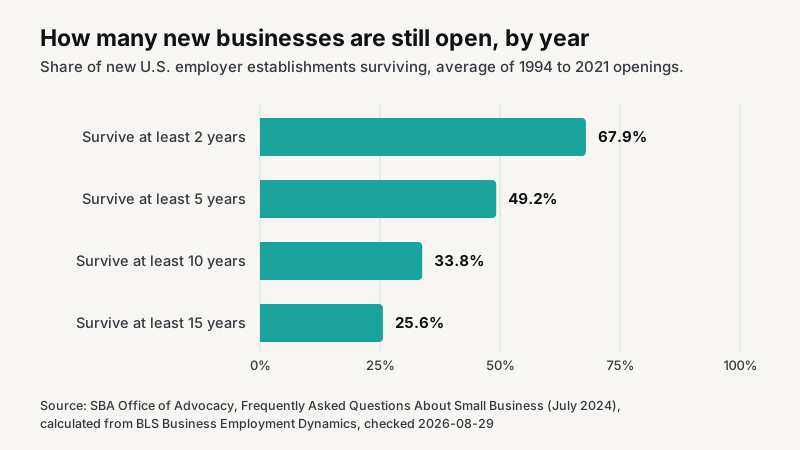
Half of new businesses are gone inside five years, and in the wellness field the ones that close are rarely the ones nobody wanted. Passion for health is not what runs out. They're the ones where the practitioner burned out carrying the whole operation in their head. Systems are how you avoid being that statistic.
What a system is, in a one-person practice
A system is anything that produces the same result without you remembering to do it. A booking page is a system. A reminder that sends itself at 9:00 am the day before is a system. A sticky note is not.
The same SBA report notes that 81.9% of U.S. small businesses have no employees at all. That's most wellness professionals. You don't have a front desk. Your systems are your front desk, and running a wellness business alone means every one of the four has to work without you.
The order matters
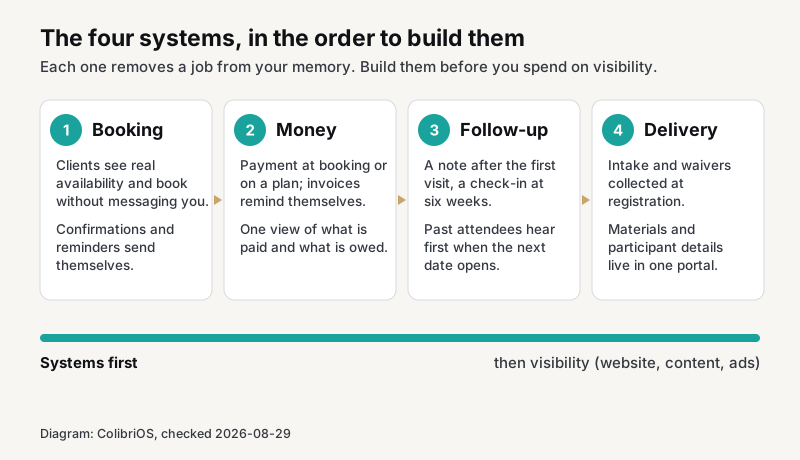
Build them in the order below. Booking comes first because it's where money and follow-up begin. Delivery comes last because it only matters once people are actually coming through the door.
1. A booking system that answers while you're in session
You are unavailable at the exact moments people want to book you, because you're holding a session, a circle, a ceremony. If booking requires a conversation with you, your busiest weeks are also your worst weeks for filling the next month.
The bar to clear
- Clients can see real availability and book without messaging you
- Events, classes and workshops have a registration page with a live seat count
- Confirmations and reminders send themselves
That last one matters more than it looks. No-shows drop with a simple automated reminder, and every reminder you don't send by hand is presence you get back.
What booking looks like on day one
If you're opening a wellness business this month, your booking system can be a single page with your services, your real hours and a way to pay. It doesn't need a full website yet. It needs to work at 10:30 pm when a potential client finally has a quiet minute to book, and it needs to hand that booking to your calendar without you touching it.
Set up a Google Business Profile that points to that page. For a local wellness space, a spa, a studio or a treatment room, that free listing brings in more first bookings than most paid advertising. It's also the first place many wellness businesses get their first review.
2. A money system that never makes it weird
Money is the place where practitioner-client relationships pick up static. Chasing an unpaid invoice after someone's had a breakthrough on your table is a conversation nobody wants.
The fix isn't to care less about money. It's to move money into a channel where no human has to bring it up.
The bar to clear
- Payment happens at booking, or on an automated plan
- Invoices send and remind themselves
- You can see, at any moment, what's been paid and what's outstanding, without doing archaeology across apps
There's a deeper benefit here too: come tax season, a practice whose income lives in one system hands its numbers to a tax preparer in an afternoon. A practice whose income lives in Venmo-plus-cash-plus-two-processors does the same in a haze of guilt in April.
The money decisions to make before you open
This is where the standard "how to start a wellness business" advice earns its place, so here it is in one pass:
- Business structure. Most solo practitioners begin as a sole proprietorship and move to a limited liability company once the practice has real income and real risk. Which is right for you is a question for an accountant or attorney in your state, not a blog post.
- Business name and license. Register the name, and check whether your city or county requires a general business license. That's separate from your professional credential.
- Insurance. Professional liability (sometimes called malpractice) covers the work you do with clients; general liability covers the space and the slip on the wet floor. Many modality associations offer both as a bundle.
- Payment processes. Pick one processor and one place where every dollar lands. Every extra channel you accept is another account you reconcile.
- Financial planning. Know your break-even: what you must collect each month to cover rent, insurance, software and your own pay. Then price so that a realistic month clears it.
Colibri helps you organize your income and expenses. It is not a tax preparer, accountant, or a substitute for professional tax advice.
3. A follow-up system, because the fortune is in the second visit
Here's a number worth sitting with: for most practices, a returning client costs roughly nothing to book, while a new one costs real marketing money and time. Yet almost all the effort goes to new clients rather than existing ones. A sustainable wellness business is built on the second visit.
The bar to clear
A follow-up system doesn't have to be a "sales funnel." It can be as simple and human as:
- A note that goes out after a first session, with one integration suggestion
- A gentle check-in when someone hasn't booked in six weeks
- An announcement to past workshop attendees when the next one opens
The reason this needs a system rather than good intentions is volume: at 30 active clients, you can hold everyone in your head. At 80, you can't, and the people who quietly drift away are exactly the ones a two-line message would have brought back.
Follow-up is also how you build trust and a brand
New practitioners hear "build your brand" and think logo. Your brand is what clients say about you to a friend, and follow-up is where that gets written. The nutritionist who checks in a week after a plan lands, the sound bath host who emails a playlist the next morning, the wellness coach who remembers the hard conversation from last month: that consistency is the brand. A strong brand in this field is mostly a follow-up system with a good heart behind it.
One rule as you collect emails and phone numbers for this: ask for consent at every door, and publish a plain privacy policy that says what you keep and why. Health information is sensitive even when it's just "sleeps badly, wants to stop." Treat it that way.
4. A delivery system for everything that isn't the session
The session is the heart, but around it lives an entire logistics layer: intake forms, pre-retreat packets, course materials, room assignments, what the co-facilitator needs to know, which participant has the shellfish allergy.
When this layer lives in your inbox, every event starts from zero. When it lives in a system, every event starts from the last one.
The bar to clear
- Intake and waivers collected at registration, not chased the week before
- Participant details visible to everyone facilitating, in one place
- Courses and materials delivered from a portal instead of email attachments
Delivery is what lets your business model grow
Most wellness businesses start with one wellness service: the session. The practices that become sustainable usually add a second layer, a group program, a course, a wellness retreat, a membership, because it lets income stop being tied one-to-one to hours on your feet. Every one of those formats is a delivery problem. If you can't send a packet, collect a waiver and let twelve people see the same schedule without twelve emails, the format will exhaust you before it pays you.
That's also why we tell new practitioners not to worry about wellness products, retreats or online programs in year one. Get the four systems steady with your core service first. Then the bigger business model is an extension of what already works, not a second job.
Where the niche, brand and business plan fit
Every guide to starting a health and wellness business, and most lists of wellness business ideas, cover the same four steps: find your niche, create a business plan, build your brand and online presence, market your wellness business. They're right, and they belong after the four systems, not before. Here's how each one looks once the systems are underneath it.
Define your niche and target audience
Your niche is not a modality. It's a person with a problem: the runner with a cranky hip, the new mother who hasn't slept, the founder whose gut health fell apart under stress. Wellness entrepreneurs who name that person clearly find that potential clients start to self-select, and the booking page does more of the selling. If you can't name the niche yet, book the next twenty sessions and look at who keeps coming back. The follow-up system will show you your niche and target audience faster than any worksheet.
Create a business plan that fits on one page
A wellness business requires careful planning, but the plan doesn't need forty pages. One page answers: what services you offer, who they're for and what health goals they bring, what you charge, what a full month looks like, what it costs to run, and which of the four systems each of those depends on. A business model that adds products or services later, a course, a membership, wellness products, fitness classes, a retreat, should be a line on that page from day one so your delivery system grows toward it.
Build your brand and online presence
Build a website when you have something to put on it: real availability, real prices, a way to pay and a few honest words about who you help. A strong brand in the health and wellness field is consistency, not decoration, and the follow-up system is where that consistency shows. Keep the tone of your marketing the same as the tone of your treatment room. A health and wellness blog, if you write one, should answer the questions your clients actually ask, in the words they use, so it's optimized for search engines without trying to be.
Market your wellness business
In the wellness industry, local businesses are your first channel: the gym down the street, the spa that doesn't offer your modality, the nutritionist who needs a bodyworker to refer to. Collaborate before you advertise. Happy clients are your best marketing, and a follow-up system that asks for a review a week after a good session will reach a wider audience than a month of posts. Whether you're running an online business, a coaching business or a treatment room, new clients arrive through the same door: someone had a good experience and there was a booking link nearby.
Questions practitioners ask when they're starting out
These are the questions that come up most often in our support inbox and in searches for how to start a wellness business. Short answers, with the honest caveats.
Do you need a license to open a wellness center?
It depends on where you are and what you do. Massage therapy, acupuncture, dietetics and counseling are licensed professions in most U.S. states; coaching, Reiki, breathwork and meditation generally are not, though scope-of-practice rules still apply. Separate from your professional credential, most cities require a general business license for any business at a physical address. Check your state licensing board and your city clerk before you sign a lease.
How much does it cost to start a wellness business?
Less than a storefront and more than zero. The lines that show up for nearly everyone: your certification or training, insurance, a business license, a booking and payment tool, a simple website or listing, and the first month or two of space if you're not renting by the hour. A room-by-the-hour practitioner with a laptop can open for a few hundred dollars in fixed setup costs; a studio with a lease and buildout is a different conversation. Write the list for your own case before you borrow anything, and know that small business loans are easier to get once you have a few months of booked income to show.
What is the most lucrative wellness business?
Nobody can tell you honestly which niche makes the most money, because the answer is "the one you can keep open." Thriving wellness businesses exist in massage, nutrition, coaching, breathwork and skincare alike. The sector data above says the money is real across the wellness industry. The survival data says most of it goes to businesses that last. In our experience, the practitioners who do best financially are not the ones in the trendiest niche; they're the ones whose money system tells them, any day of the week, exactly where they stand.
How long does it take to start a wellness business?
The paperwork takes days. The systems take a few focused evenings, and they are the business decisions that pay off longest. Filling the calendar takes months, which is why you want the systems in place before that season begins, not during it.
The honest sequence
Notice what's not on this list: a prettier website, a content strategy, a niche statement. Those matter, later. The sequence that works is systems first, then visibility, because visibility multiplies whatever it lands on. If it lands on a leaky container, it multiplies leaks.
Ilene Frahm, who helped build the EMyth coaching company and edited The E-Myth Revisited, frames the question every owner eventually has to answer:
How would your business have to operate if it couldn’t depend on you to personally produce results?
Ilene Frahm, CEO and board chair of EMyth, EMyth
For a practitioner, the answer is not "hire a team." It's "build the four systems," so that the parts of the business that don't need your hands stop needing your hands. That is what a successful wellness business looks like from the inside: the practitioner delivering an exceptional experience in the room, and the systems doing the rest.
You can build these four systems out of separate tools, a scheduler, a payment app, an email tool, a folder of PDFs, and many wellness professionals do, until the duct tape becomes its own part-time job. You can also collaborate with a peer, sharing a studio or a booking page, which spreads the cost but not the reconciling.
Colibri exists because we think the four systems belong in one place, designed for how healing work actually flows: bookings, money, follow-up, and delivery under one roof, so the practitioner can go back to being present. If your practice is running on duct tape, start a free 30-day trial, set up the first system this week, and add the rest as you're ready.
Updated
About the author

Stephanie Holbrook
Founder, ColibriOS
Stephanie Holbrook is the founder of ColibriOS. She runs Dragonfly Web Designs from Silver City, New Mexico, and is the friend people call when the bank statements and the mileage log need sorting before tax time. She builds software for practitioners and retreat hosts who would rather be with their people than in a spreadsheet, and writes about pricing, bookings and the bookkeeping side of running a practice.
More about the people behind ColibriOSRun your practice from one place
Bookings, payments, retreats, and follow-up. Colibri keeps the admin light so you can stay present.
Join free until Cyber MondayGet the launch notes
One email when something worth knowing happens: launch pricing, what shipped, new videos. No noise. Unsubscribe any time.
By signing up you agree to receive emails from ColibriOS. Unsubscribe any time.