How to Price a Wellness Retreat (With a Real Working Example)

Pricing a retreat is where many gifted facilitators freeze. You can hold space for twenty people moving through deep process, but ask you to set a price and suddenly the spreadsheet stares back.
Here's the pattern we see over and over: practitioners price from feeling, what seems fair, what a peer charged, what feels safe to ask. Then the retreat fills, the work is beautiful, and the math quietly loses money.
Let's fix that with an actual method.
What wellness travelers already spend
Before you decide what to charge, it helps to know what the people you're pricing for are used to paying.
The market you are pricing into
The Global Wellness Institute tracks this every year. In its Global Wellness Economy Monitor 2025, three numbers matter for anyone setting a retreat price:
- Wellness tourism was a $894 billion market in 2024, the fourth largest sector of the wellness economy, and GWI projects it will reach $1,383 billion by 2029.
- People took 1,239.5 million wellness trips in 2024, and 87% of them were domestic. Your guests are far more likely to drive than to fly.
- Domestic wellness travelers spend 137% more per trip than ordinary domestic tourists. International wellness travelers averaged $1,637 per trip, 38% more than the typical international tourist.
That last one is the one to sit with. The person considering your retreat has already decided that this kind of travel is worth more than a normal trip. You are not talking them into a premium. They arrived expecting one.
Why the average trip is not your price
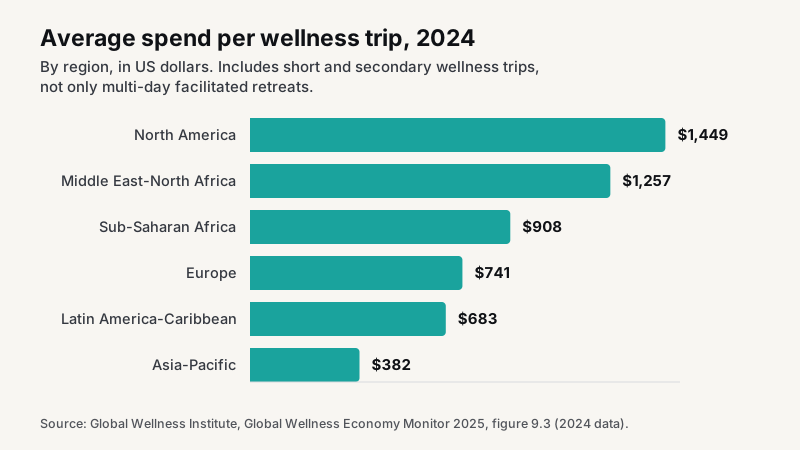
Be careful with that $1,449 North America figure. It is the average spend across every wellness trip, including short getaways and business trips where someone booked a spa afternoon. It is not the price of a facilitated multi-day retreat, and it is not your ceiling. Most hosted retreats sit well above it.
Use it as context, not as a target. Your price comes from your costs.
Start with the true cost per participant
List every cost the retreat incurs, in three buckets.
Fixed costs
The same whether 8 people come or 20:
- Venue rental for the full stay
- Your travel and lodging
- Co-facilitator fees (a flat rate, or an agreed revenue split)
- Insurance and permits
- Marketing spend
Per-person costs
These are your variable costs, and they scale with each registration:
- Meals and catering
- Lodging, if billed per head
- Supplies (journals, mats, ceremony materials)
- Payment processing (~3% of the ticket price)
The hidden costs most retreat leaders forget
These are the lines that quietly eat a margin that looked fine on paper:
- Currency and transfer fees on an overseas venue deposit
- The refund buffer for the one guest who cancels inside your policy window
- Airport transfers you assumed were included and were not
- Taxes on the income, which is not the same as your profit
- The extra night you book on either side so you are not facilitating on travel fumes
Your time
The one everyone forgets. Count preparation weeks, the retreat days themselves, and integration follow-ups. Give that time an honest hourly value. If you skip this line, you haven't priced a retreat; you've priced a volunteer engagement with catering.
A worked example
Say you're hosting a 4-day somatic retreat for up to 16 people at a desert venue:
| Item | Cost |
|---|---|
| Venue (4 nights, exclusive use) | $6,000 |
| Co-facilitator | $2,400 |
| Your travel + prep + facilitation time | $4,000 |
| Insurance, permits, marketing | $1,600 |
| Fixed subtotal | $14,000 |
| Meals per person (4 days) | $260 |
| Supplies per person | $40 |
Divide by your realistic minimum, not your maximum
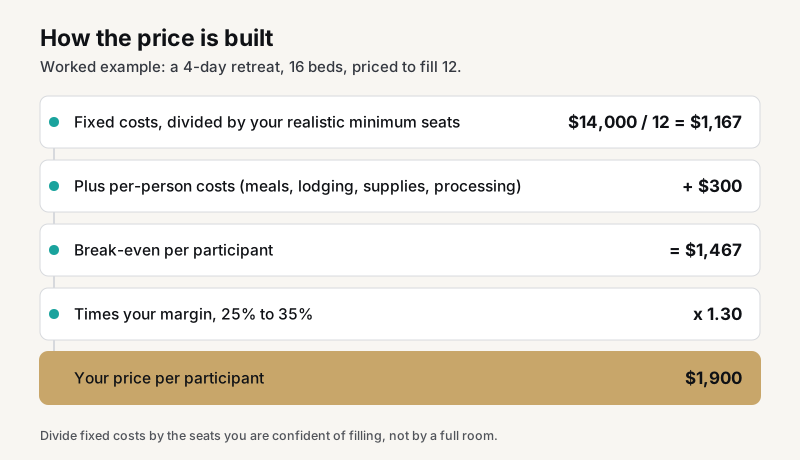
Here's the crucial move. If you're confident you can fill 12 of 16 seats:
- Fixed cost per person: $14,000 ÷ 12 = $1,167
- Per-person costs: $300
- Break-even per participant: $1,467
Add your margin
25 to 35% is a healthy range for a first-run retreat:
- $1,467 × 1.30 ≈ $1,900 per participant
At 12 participants you earn your margin. Seats 13 to 16 are almost pure profit, because the fixed costs are already covered. That's your cushion, not your plan.
The early-bird math most hosts get backwards
Early-bird pricing isn't a discount, it's cash-flow insurance. Venue deposits come due months before final payments arrive. A well-built early-bird tier gets deposits in your account when you need to pay deposits out.
Rule of thumb: price the early tier at your break-even ($1,450 to $1,500 in the example), cap it at the number of seats whose revenue covers your venue deposit, and let the remaining seats carry the full margin.
Payment plans widen your circle without shrinking your margin
A $1,900 ticket is a hard yes for many of the people who most need the work. Three payments of $650 is a much easier yes, and it's more total revenue, not less. The small premium (~2.5%) covers your added processing cost and the risk of a missed installment.
Two guardrails:
- Final payment lands at least 21 days before the retreat. You need time to fill a seat if someone's plan falls through.
- Automate the schedule. Chasing installments by text message is the fastest way to bring transactional energy into a relationship you want to keep sacred.
The mistake that costs the most: pricing too low
Underpricing feels safe and generous. It is usually neither. Shannon Jamail, a retreat leader and mentor who trains other hosts, puts the cost of guessing plainly:
If you don't know these numbers clearly, you are guessing. And guessing is how retreat leaders end up working for free.
Shannon Jamail, retreat leader and mentor, The Retreat Leaders Playbook
A low price also does not sell the way people expect. It signals lower value, and it tends to attract guests who are shopping on cost rather than on the work. Retreats do not have volume to make it up with. They have twelve to twenty souls and a fixed number of beds.
What to do when the numbers feel too high
If your worked price lands above what your community can bear, resist the urge to quietly shave your own time line to zero. Instead:
- Change the venue math. A venue at 70% of the cost changes the price more than any other line.
- Shorten by one night. A 3-day retreat at $1,400 often fills faster than a 4-day at $1,900.
- Add one scholarship seat, transparently. Priced into everyone else's ticket, it lets you hold the door open without eroding the whole structure.
What doesn't work: pricing below break-even and hoping volume saves you.
Keeping the math true after the retreat fills
The method above only works if you can see the numbers while the retreat is filling: deposits in, installments pending, per-person costs updating as registrations land. If that lives across a spreadsheet, a payment app, and your memory, you'll be re-deriving your break-even at midnight in week six.
This is the exact problem ColibriOS was built for: registrations, payment plans, and retreat finances in one place, so the math you did here stays true through the last installment. If you're pricing a retreat right now, start a free 30-day trial and build it in as you go.
Colibri helps you organize your income and expenses. It is not a tax preparer, accountant, or a substitute for professional tax advice.
Updated
About the author

Stephanie Holbrook
Founder, ColibriOS
Stephanie Holbrook is the founder of ColibriOS. She runs Dragonfly Web Designs from Silver City, New Mexico, and is the friend people call when the bank statements and the mileage log need sorting before tax time. She builds software for practitioners and retreat hosts who would rather be with their people than in a spreadsheet, and writes about pricing, bookings and the bookkeeping side of running a practice.
More about the people behind ColibriOSRun your practice from one place
Bookings, payments, retreats, and follow-up. Colibri keeps the admin light so you can stay present.
Join free until Cyber MondayGet the launch notes
One email when something worth knowing happens: launch pricing, what shipped, new videos. No noise. Unsubscribe any time.
By signing up you agree to receive emails from ColibriOS. Unsubscribe any time.